

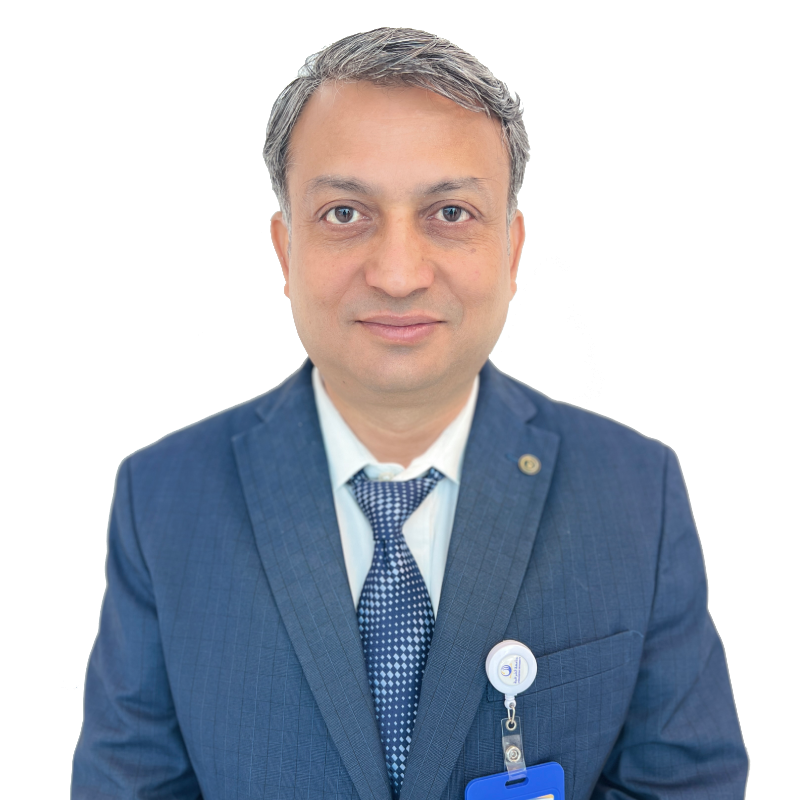
R. K. Choudhary
Associate Professsor College of Applied and Health Sciences
- Job Title
- Associate Professsor
- College
- College of Applied and Health Sciences
- Phone
- +96898513334
Dr. Ranjay Kumar Choudhary is an accomplished academician, biomedical researcher, and healthcare professional with over two decades of experience in higher education, translational research, curriculum development, laboratory quality management, and clinical diagnostics across India, Saudi Arabia, and Oman. Holding a PhD in Medical Laboratory Technology and an MBA in Education Management, he has served in progressive academic leadership roles, including Professor, Head of Department, and Quality Lead. He has taught diverse courses in medical laboratory sciences, supervised 30 master’s dissertations and three PhD theses, and mentored numerous students in research and professional development. His multidisciplinary research spans infectious diseases, molecular diagnostics, immunology, metabolic disorders, microbiome science, natural product therapeutics, extracellular vesicles, and precision medicine, with notable contributions to HIV diagnostics, transfusion-transmitted infections, COVID-19 predictors, cancer signaling pathways, neuroprotection, PCOS, metabolic syndrome, and AI-driven immunotherapy. He has completed several funded projects, published extensively in Scopus and Web of Science-indexed journals, and secured multiple patents for innovative diagnostic technologies. A licensed Specialist Laboratory Scientist and certified internal auditor, Dr. Choudhary is also experienced in OBE-driven curriculum design, accreditation standards (NCAAA, ABET, AHPGS, NAAC), and laboratory QA/QC systems. He continues to contribute actively to advancing medical laboratory sciences and interdisciplinary biomedical research at regional and global levels.
Diploma, Bachelor, Master, PhD in Medical Laboratory Sciences, MBA in Education Management
Dr. Ranjay Kumar Choudhary is a multidisciplinary biomedical researcher with extensive contributions across infectious diseases, molecular diagnostics, immunology, metabolic disorders, microbiome science, natural product therapeutics, and advanced biomedical technologies. His research focuses on understanding molecular and inflammatory mechanisms of disease and translating these insights into innovative diagnostic and therapeutic solutions with strong translational and public health relevance.
He has made significant contributions to infectious disease research, particularly in HIV diagnostics, transfusion-transmitted infections, and COVID-19 clinical predictors. His work on natural metabolites and medicinal plants has provided important mechanistic insights into cancer signaling, chemoprevention, and neuroprotective strategies, including nitric oxide synthase inhibition. Dr. Choudhary’s research also addresses metabolic and inflammatory disorders such as PCOS, metabolic syndrome, and gut–inflammation–microbiome interactions.
In immunology, he has advanced understanding of cytokine networks, autoimmune mechanisms, and AI-driven approaches to personalized immunotherapy. His expertise extends to modern molecular diagnostics, including exosomal RNA biomarkers, advanced healthcare diagnostic platforms, bioinformatics, molecular docking, and precision medicine technologies. He has also contributed to extracellular vesicle research, exploring their roles in cancer progression, drug delivery, and vaccine development.
Additional contributions include work on cardiovascular and neurological disorders, network pharmacology approaches, forensic toxicology, and emergency diagnostic innovations. Across his publications, Dr. Choudhary demonstrates strong methodological expertise in molecular biology, biomarker discovery, natural compound pharmacology, microbiome analytics, and translational research design. His body of work, published in reputable international journals, spans basic, clinical, and applied biomedical research, with growing impact in emerging fields such as exosomes and AI-assisted healthcare.
Journal paper
Registered professional license from Saudi commission of health specialist Designation: Specialist Laboratory License number- 15-RA-00-46072.
Certified Internal auditor of OHSAS: 80001:2007. From TUV SUD Middle east L.L.C.
Registered professional license from Uttarakhand Paramedical council, Dehradun. Laboratory License number- 3845/315 MLT.